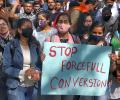
The Uttar Pradesh assembly on Tuesday passed the UP Prohibition of Unlawful Conversion of Religion (Amendment) Bill, 2024 that provides for a maximum punishment of life imprisonment, making the law stricter in cases of fraudulent or forced conversion.

The state cabinet presided over by Chief Minister Yogi Adityanath had earlier this week approved the draft ordinance to curb forcible or "dishonest" religious conversions including those for the sake of marriage, which could land violators in jail for up to 10 years.

Based on a complaint from Tikaram, a resident of Sharif Nagar village in Devarniya, the case was registered under sections of the Indian Penal Code and the anti-conversion law.

The Allahabad high court, which is hearing an appeal in connection with the case, has been informed that there is no evidence that the two men tried to change the woman's religion.

They alleged that the Uttar Pradesh Prohibition of Unlawful Conversion of Religion Ordinance was being used to "victimise especially those Indian men who are Muslim and women who dare to exercise their freedom of choice".

A prominent Islamic shrine in Bareilly has issued a decree banning religious conversion by force or allurement, endorsing Uttar Pradesh's recent ordinance aimed at curbing inter-faith marriages as an alleged ploy for conversion.
Three years ago, the accused started exerting pressure on her to undergo religious conversion and perform 'nikaah' (marriage). But when the woman opposed, he threatened to kidnap her, Tikaram alleged.

The Madhya Pradesh cabinet on Tuesday gave nod to an ordinance on the bill against religious conversion through fraudulent means, including those for the sake of marriage, that stipulates a jail term of up to 10 years for violators.

The woman said she is an adult and married the man a few months ago of her free will. It was not immediately known whether she also changed her religion.

The Madhya Pradesh cabinet on Saturday approved the Religious Freedom Bill 2020, which provides for prison term of up to 10 years and fine of Rs 1 lakh for conversion through marriage or by any other fraudulent means, state Home Minister Narottam Mishra said.

Making such publication mandatory would invade in the fundamental rights of liberty and privacy, the Lucknow bench of Allahabad high court said.

Sarma said, "It will be mandatory for all marriages. There will be a disclosure pro forma given to a wife who'll give it to her husband. It won't be only about religion but everything that a wife needs to know. It won't be in line with Madhya Pradesh and Uttar Pradesh. It'll be empowering women."
"Both the women have claimed themselves to be adults on the basis of official documents and married youths of other community on their own accord. These incidents have nothing to do with love jihad," Bareilly's Senior Superintendent of Police Rohit Singh Sajvan said on Saturday.

Kamalrukh said she is a Parsi who got married to the "Dabangg" composer under the Special Marriages Act.
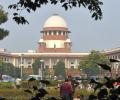
The pleas, filed by advocate Vishal Thakre and others and an NGO 'Citizens for Justice and Peace', have challenged the Constitutional validity of the Uttar Pradesh Prohibition of Unlawful Religious Conversion Ordinance, 2020 and the Uttarakhand Freedom of Religion Act, 2018 which regulate religious conversions of interfaith marriages.
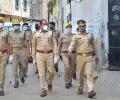
The man and the woman turned out to be both Muslims and adults. Kushinagar Superintendent of Police Vinod Kumar Singh said someone from Gurnia village had informed them on Tuesday that a couple was getting 'quietly' married there, and suspected it to be a case of 'love jihad'.
A bench headed by Chief Justice S A Bobde refused, however, to stay the controversial provisions of the laws and issued notices to both state governments on two different petitions.
Nearly a dozen first information reports have been lodged since the Prohibition of Unlawful Conversion of Religion Ordinance, 2020, was notified on November 27.

Since 2014, India has left its moorings as a pluralist, modern, secular State because that is how the BJP wants it to be, notes Aakar Patel.

'Whom do I want to marry and what decisions I make for marrying the person I love are totally personal decisions, in which neither the State nor the courts have any right to interfere.'

The most strident criticism of UP's anti-conversion ordinance has come from the judiciary with several retired Supreme Court and high court judges having described it as being violative of Article 14 (Right to Equality), 15 (Prohibition of discrimination on grounds of religion), 21 (Right to Life) and 25 (Freedom of conscience) of the Constitution, points out Rashme Sehgal.

The woman sought protection for her and her family as also her right to privacy, saying that because of her conversion she and her family are being targeted and malicious content is being published in media which should be stopped immediately.
 © 2026 Rediff.com - Advertise with us - Disclaimer - Privacy Policy - Sitemap - Feedback - About us - Terms of use - Grievances